Halal Logistics: Where Certification Quietly Breaks Down
A product can be certified halal at the factory and lose its integrity in a shipping container. Halal logistics is the least glamorous part of the Islamic economy and arguably the weakest link. We examine segregation, cold chain and the standards gap.
GIMAC Editorial Team
·30 July 2026
·5 min read
Halal certification is overwhelmingly discussed as a question about products: what is in them, how the animal was slaughtered, which authority approved the formulation. This framing has a blind spot large enough to drive a lorry through, which is roughly what happens.
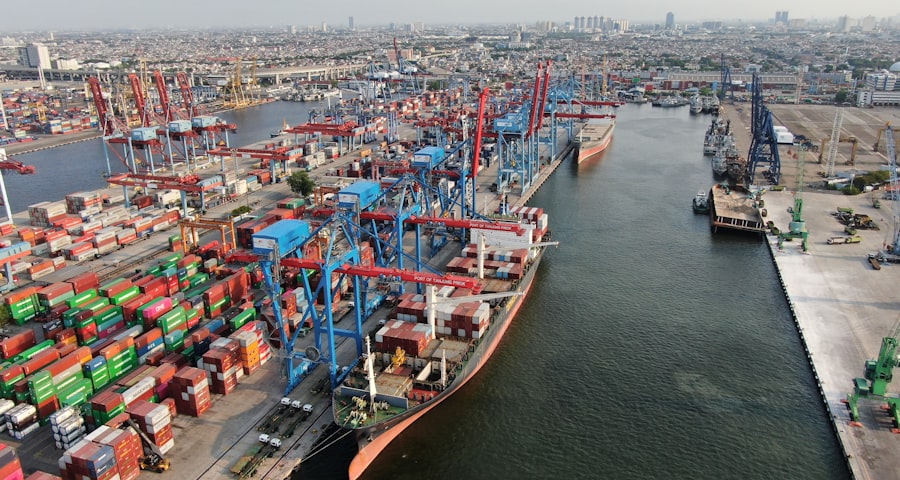
Between a certified facility and a consumer’s kitchen sit port handling, container consolidation, break-bulk warehousing, cross-docking, third-party cold storage and last-mile delivery. At each of these points, certified product may be handled on the same equipment, stored in the same chamber and moved in the same vehicle as non-halal goods. In most of the world, nothing prevents this, and nothing records it.
What Halal Integrity Requires in Transit
The jurisprudential requirement is straightforward to state. Halal product must not come into contact with najis, ritually impure, substances, principally pork and its derivatives, and alcohol. It must not be commingled in ways that render its status uncertain. Where contact has occurred, equipment requires cleansing according to specified procedures, which for porcine contact in the Shafi’i school traditionally involves a ritual wash including earth or an approved equivalent.
Translating that into logistics operations produces a demanding specification:
- Dedicated or properly cleansed containers and trailers: not merely swept out between loads
- Segregated storage, with physical separation rather than shelf labelling
- Documented cleansing procedures where shared assets are used, with auditable records
- Segregated handling equipment: pallets, forklifts, conveyor surfaces
- Chain-of-custody documentation that survives every transfer of responsibility
Very little of this is standard practice outside a small number of dedicated operators.
The Consolidation Problem
The economics of freight work directly against segregation. Less-than-container-load shipping exists because filling a container with a single consignor’s goods is often uneconomic. Consolidation is the default, and a consolidated container may carry certified halal foodstuffs alongside anything else the freight forwarder booked that week.
Cold chain compounds this. Refrigerated capacity is expensive and scarce, particularly on long-haul routes into and within Muslim-majority markets. A shipper who insists on a dedicated reefer pays a substantial premium and may simply not find capacity. The commercial pressure to accept mixed loading is constant.
Three consequences follow:
Certification becomes point-in-time rather than continuous. The certificate attests to conditions at the point of production. It says nothing about the six weeks that followed.
Liability is diffuse. When integrity is compromised in transit, responsibility is distributed across a producer, a forwarder, one or more carriers, a port operator and a warehouse, none of whom holds the certificate.
Detection is nearly impossible. Unlike an ingredient substitution, a segregation failure leaves no trace in the finished product. There is no test that identifies a pallet that shared a chamber with pork.
Where Standards Exist
The standards landscape is less developed than in food processing but not empty.
Malaysia’s MS 2400 series remains the most cited framework, covering halal requirements for transportation, warehousing and retail as distinct disciplines. It is genuinely operational rather than aspirational, it specifies segregation, cleansing and documentation in terms an auditor can check.
The OIC/SMIIC standards developed through the Standards and Metrology Institute for Islamic Countries include supply-chain provisions and represent the most serious attempt at cross-border harmonisation to date. Adoption remains uneven.
The UAE’s ESMA scheme and the emerging Saudi framework under SFDA both address logistics, reflecting the Gulf’s structural position as a food-importing region that must take chain-of-custody seriously.
The gap is not the absence of standards. It is that compliance is voluntary along most of the route, and the parties with the strongest commercial incentive to comply, brand owners, have the least direct control over the parties who determine whether it happens.
The Port Strategy
Several jurisdictions have concluded that the practical answer is infrastructure rather than regulation, building dedicated halal logistics capacity as a competitive proposition.
Malaysia’s halal parks pair certified manufacturing with adjacent certified warehousing and port access, allowing product to move from production to vessel without leaving a controlled environment. Dubai’s positioning as a halal trade hub follows similar logic at greater scale, leveraging Jebel Ali’s transhipment volumes. Indonesia, Türkiye and several Gulf states have announced comparable projects.
The economic argument is that integrity is easier to guarantee through a controlled corridor than to verify across an open network, and that whoever operates the corridor captures the trade. Whether these investments generate returns proportionate to their cost is not yet clear; several are recent, and published utilisation data is scarce.
Where Technology Actually Helps
Blockchain traceability has received the bulk of the attention in this area, and it addresses a genuine problem, but a narrower one than is often claimed. A distributed ledger records what was attested; it does not verify that the attestation was true. If a driver states that a trailer was cleansed and it was not, the ledger faithfully preserves a false record.
The more consequential technology is duller and more physical:
- IoT sensors logging temperature, door-open events and geolocation continuously, producing evidence rather than assertion
- Tamper-evident seals with digital verification at each custody transfer
- RFID and container-level tagging that makes segregation auditable after the fact
- Warehouse management systems with halal status as a first-class attribute governing slotting decisions, rather than a note in a comments field
Combining these with a ledger is genuinely powerful, because the ledger then records sensor evidence rather than human claims. Several pilots in Southeast Asia and the Gulf are pursuing exactly this combination. Published results remain limited.
The Research Agenda
Halal logistics sits at an intersection (operations research, supply chain management, Islamic jurisprudence and consumer trust) that few researchers are equipped to cover, which partly explains how thin the literature is. Productive questions include:
- What is the actual rate of integrity failure? Nobody knows, because detection is nearly impossible and reporting incentives are negative. Even a rough estimate would reframe the field.
- What premium does segregated logistics command, and who pays it? The cost falls on shippers; the benefit accrues to brands and consumers. That misalignment is the central economic problem and it is barely modelled.
- Do consumers understand that certification is point-in-time? Almost certainly not, which raises a question about whether current certification marks communicate accurately.
- Would corridor infrastructure or mandatory chain-of-custody standards deliver integrity more efficiently? This is an empirical comparison that has not been attempted.
The last point matters most. The halal industry has invested heavily in verifying products and comparatively little in verifying the journey. For a supply chain that spans continents, that allocation looks increasingly difficult to defend.
Published by
GIMAC Editorial Team
30 July 2026
GIMAC 17 · Alanya, Turkey · October 2026
Present at GIMAC 17
Submit your research on the topics explored in this article. Extended submission deadline: 27 September 2026.